Antinous
Antinous, son of Eupeithes, is the foremost and most vicious of the suitors who overrun Odysseus's house in Ithaca. He is the ringleader of their insolence, the architect of the plot to murder Telemachus, and the first to die when Odysseus reveals himself. His death—an arrow through the throat as he lifts a golden wine cup—opens the slaughter that restores order to the kingdom, making him the embodiment of the suitors' hubris and its necessary punishment.
Identity and Background
Antinous is introduced as the son of Eupeithes, a man of standing in Ithaca. He is repeatedly described as the chief among the suitors, the one whose words carry the most weight and whose cruelty sets the tone for the others. When Telemachus first addresses the assembly to denounce the suitors' waste of his estate, it is Antinous who rises to answer, mocking the young prince as an "insolent braggart" and laying the blame for the suitors' presence squarely on Penelope's cunning—her famous weaving trick. He is the first to speak against Telemachus and the last to show any restraint, establishing himself from the outset as the primary antagonist.
Role as Ringleader of the Suitors
Antinous dominates the suitors through both his wealth and his aggressive will. He is the one who proposes the ambush to kill Telemachus on his return from Pylos, declaring, "Find me a ship, therefore, with a crew of twenty men, and I will lie in wait for him in the straits between Ithaca and Samos; he will then rue the day that he set out to try and get news of his father." When the suitors gather for the feast, it is Antinous who scolds the swineherd Eumaeus for bringing the disguised Odysseus to the house, and who later throws a footstool at the beggar, striking him on the right shoulder. The other suitors occasionally express unease at his brutality—one young man warns that the stranger might be a god in disguise—but Antinous pays them no heed, confident in his own power and contemptuous of all restraint.
Conflict with Telemachus and Penelope
Antinous's hostility toward Telemachus is personal and unrelenting. He taunts the young prince openly, wishing that Jove would never grant him to be chief in Ithaca as his father was. When Telemachus stands up to him in the assembly, Antinous responds with sarcasm and threats, not with conciliation. He also shows open contempt for Penelope, accusing her of deceit and manipulation, and declaring that the suitors will not leave her house until she marries one of them. His words to Penelope are laced with a cold, calculating cruelty: he acknowledges her cleverness but treats it as a provocation that justifies the suitors' continued plunder.
The Bow Contest and Death
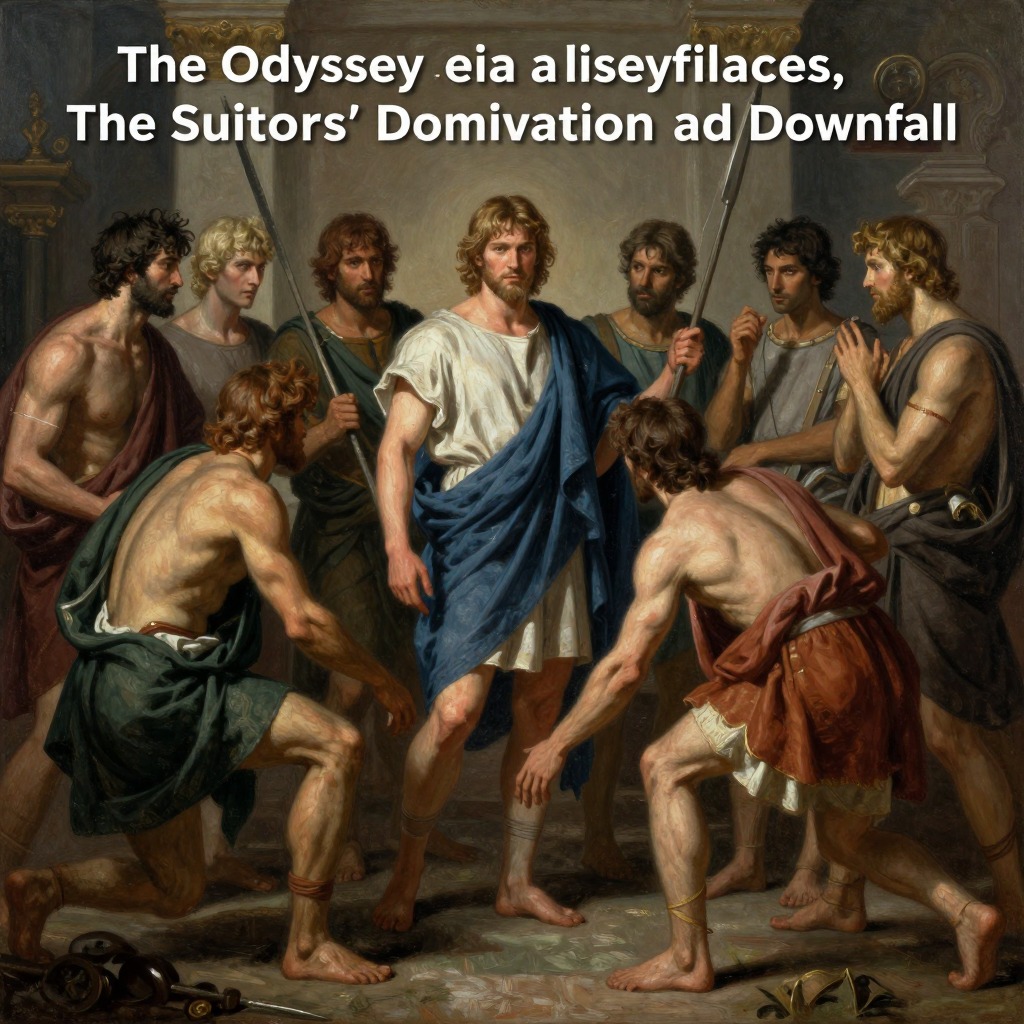
On the day of the bow contest, Antinous is confident that he will string the bow and win Penelope. He scolds Leiodes for failing, orders the bow to be warmed and greased, and takes his turn with full expectation of success. But when Odysseus, still disguised as a beggar, asks to try the bow, Antinous erupts in fury, threatening to ship him off to King Echetus, who kills every stranger. It is Antinous who most fiercely opposes giving the beggar a chance. When Odysseus strings the bow with ease and shoots through the axes, Antinous is caught completely off guard. As he reaches for his wine cup, Odysseus's arrow strikes him in the throat, the point passing clean through his neck. He falls, the cup drops from his hand, and a thick stream of blood gushes from his nostrils. He kicks the table over, spoiling the bread and meat, and dies instantly. Eurymachus later tries to blame all the suitors' crimes on Antinous, calling him "the head and front of the offending," but Odysseus rejects the plea, and the slaughter continues.
Thematic Significance
Antinous functions as the embodiment of the suitors' collective hubris—their arrogant belief that Odysseus will never return and that they can violate his house, his wife, and his son with impunity. His death is the first and most symbolically charged of the massacre: the arrow that kills him as he lifts a cup of wine is a direct inversion of the hospitality he has abused. He who feasted without restraint on another man's goods is struck down at the moment of his own pleasure. His fate also serves as a warning about the limits of aristocratic privilege: despite his wealth, his lineage, and his position as leader of the suitors, he cannot escape the justice that Odysseus brings. In the underworld, the ghost of Agamemnon praises Odysseus for having a wife as faithful as Penelope, contrasting her virtue with Clytemnestra's treachery—but it is Antinous's death that makes that fidelity meaningful, for it is his violence and greed that most threaten the house of Odysseus.